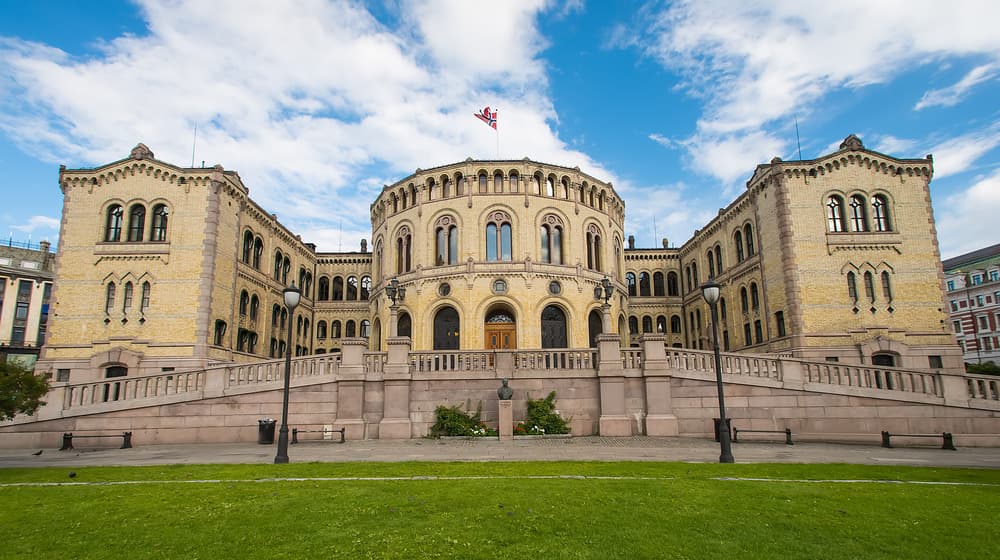
Parliament Square
Parliament Square
Seat of the Norwegian Parliament since 1866, Stortinget can be visited free of charge in summer at the heart of Oslo, on Karl Johans gate.
Stortinget, seat of the Norwegian Parliament, occupies a central position on Karl Johans gate, the main artery of Oslo. Inaugurated in 1866, the building houses the country's democratic institution and remains accessible to the public through guided summer tours.
Why visit Stortinget
The Norwegian Parliament offers a concrete entry point for understanding the country's political functioning and institutional history. The visit appeals equally to enthusiasts of 19th-century architecture and travellers curious about the Scandinavian democratic model. Located at the heart of Oslo, it lends itself to a brief stop (around one hour) as part of a broader discovery of the city centre, between the Royal Palace to the west and the cathedral to the east.
History of Stortinget
The roots of Norwegian parliamentarianism trace back to Scandinavian popular assemblies, the ting or alltings, documented from the Viking era (around the 9th century). These regional gatherings served to settle disputes and adopt common rules, under the progressive influence of the Crown.
The modern Storting was born in 1814 with the Norwegian Constitution, adopted at Eidsvoll in the context of separation from Denmark. The assembly initially operated from temporary premises before the current building, designed by Swedish architect Emil Victor Langlet, was inaugurated in 1866. Its façade of yellow brick and stone, inspired by neo-Romanesque architecture with Italianate influences, has marked Oslo's urban landscape for more than a century and a half.
The institution underwent major structural reform in 2009: previously divided into two internal chambers (Odelsting and Lagting), it became strictly unicameral. Storting now comprises 169 members elected every four years through proportional representation.
What to see during your visit
The building's exterior
The rotund façade on the Eidsvolls plass side stands out with its semi-circular central body flanked by two rectangular wings. The carved details, rounded arches and polychromatic materials illustrate the codes of 19th-century European parliamentary architecture. The forecourt and surrounding lawns form an open public space, frequented by residents and political demonstrations alike.
Interior rooms
Guided tours provide access to several key spaces: the plenary chamber where the 169 deputies sit, arranged in a hemicycle; certain reception halls decorated with frescoes and portraits; and spaces dedicated to the institution's history. Guides recount the typical course of a session and explain the role of political parties in the Norwegian political system.
Public sessions and exhibitions
Outside guided tour periods, certain plenary sessions remain open to the public from the galleries, with prior registration. Temporary exhibitions on Norwegian political history or contemporary themes are also offered in the entrance hall.
Practical information
- Guided tours: offered in summer (typically from late June to mid-August), on weekdays, in the mornings. Free of charge, no reservation required, limited to 30 people per group — arriving early is recommended.
- Languages: tours in Norwegian and English depending on the day.
- Security check: mandatory at the entrance, with bags and outerwear to be deposited at the cloakroom.
- Photography: allowed inside, except at the security checkpoint.
- Accessibility: elevators available for people with reduced mobility.
- Guide dogs: permitted.
How to get there
Stortinget is located at Karl Johans gate 22, in the centre of Oslo. Access is mainly on foot once in the city.
- By tram: Stortinget stop, served by lines 11, 12 and 18, just metres from the building.
- By metro: Nationaltheatret station, about 5 minutes' walk. The Stortinget metro station also serves the area.
- From Oslo Central Station (Oslo S): allow about ten minutes on foot heading up Karl Johans gate.
- From Oslo-Gardermoen Airport: the Flytoget (express train) or regional trains connect the airport to Oslo S in 20 to 25 minutes.
- By car: not recommended. The city centre has traffic restrictions and parking is scarce and expensive.
Nearby attractions
Stortinget lends itself well to a wider walk through Oslo's centre. Karl Johans gate connects within a few hundred metres the Royal Palace, the National Theatre and the cathedral. To extend your visit, the Vigeland Park and its monumental sculptures are found to the west of the city, accessible by tram. Beyond Oslo, travellers seeking to complete their itinerary in Norvège can reach Sognefjord or Geirangerfjord, two of the country's most striking fjords.
Frequently asked questions
Frequently asked questions
Plan your trip
A visit to Stortinget fits naturally into a stay in Oslo or a wider tour through Norwegian fjords and cities. To build a bespoke itinerary, explore our range of travel packages in Norvège.

Interested in this visit?
We can include it in your personalised itinerary.