Bergenhus Fortress
Bergenhus Fortress
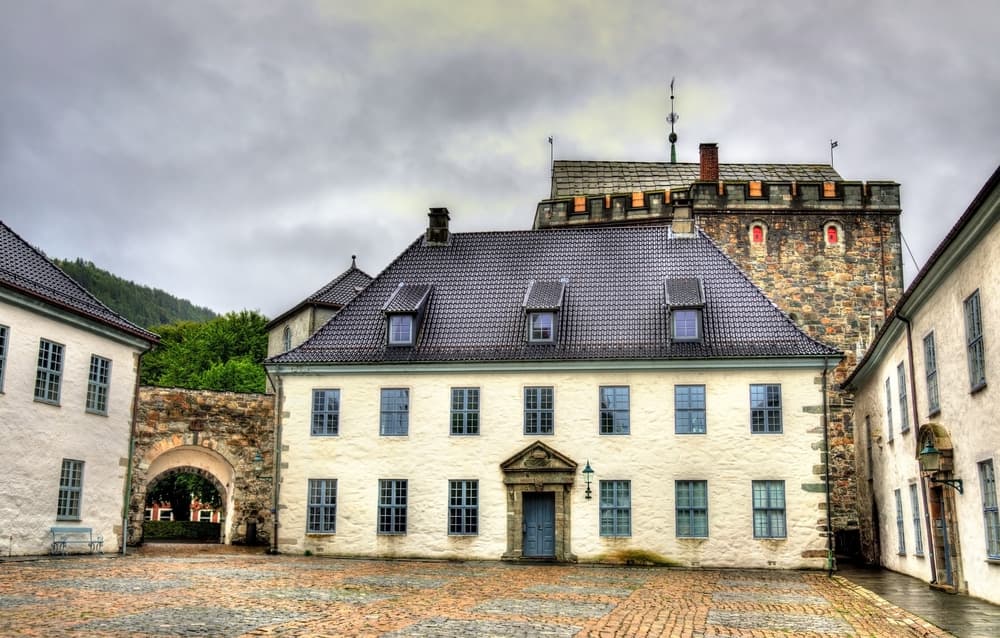
At the tip of Bergen harbour, Bergenhus brings together a 13th-century medieval hall, Rosenkrantz Tower and traces of World War II.
Perched at the northern tip of Bergen harbour, Bergenhus fortress combines medieval buildings, modern fortifications and traces of World War II on a single site. A former Norwegian royal residence, the site remains one of Scandinavia's best-preserved fortified complexes and a landmark of Bergen's historic centre.
Why visit Bergenhus
Bergenhus offers a concentrated account of eight centuries of Norwegian history. Within a few hectares, you move from the medieval banqueting hall of Håkon to a Renaissance tower, from a Romanesque church to a World War II bunker. Access to the ramparts and lawns is free, making it also a recreational space used by locals, just steps away from the UNESCO-listed Bryggen wharf.
The site remains active: it hosts military ceremonies, concerts and several festivals each year. It's a logical complement to exploring the old town, particularly for travellers interested in medieval history and World War II.
History in layers
The fortified site of Bergenhus dates back to the Middle Ages: Håkon Hall (Håkonshallen) dates from the 13th century, when Bergen was the capital of the Kingdom of Norway. Rosenkrantz Tower was built in the 16th century around an older medieval core, and the complex was gradually reinforced during the 17th century to become a true stronghold by around 1700.
Bergenhus played a strategic role during the Battle of Vågen in 1665, when the fortress withstood an English attack after a Dutch fleet had taken shelter in Bergen harbour. During World War II, German forces made it their western headquarters; a bunker was then built on the site by Soviet prisoners of war. In 1944, the explosion of a German cargo ship loaded with munitions in Vågen harbour severely damaged several historic buildings. Post-war restoration extended into the 1960s and allowed the medieval volumes to be recovered, notably those of Håkonshallen.
What to see on the site
- Håkon Hall (Håkonshallen): 13th-century royal banqueting hall, restored after the 1944 explosion. It is the most impressive medieval building on the site.
- Rosenkrantz Tower: a combination of defensive tower and residence, accessible for interior visits; the upper platform offers a wide view over the harbour and the old town.
- St. Mary's Church (Mariakirken): a Romanesque building located in immediate proximity, among the oldest surviving buildings in Bergen.
- World War II bunker: a remnant of German occupation, built by Soviet prisoners.
- Ramparts and lawns: free walk around the enclosure, views over the harbour basin and Bryggen.
When to visit
Bergen has a rainy oceanic climate year-round. The best time to visit Bergenhus is from late May to early September: long days, mild temperatures and a dense cultural programme. The Bergen International Festival (late May–early June) and the Bergen Medieval Festival regularly invest the site with concerts, re-enactments and markets. In winter, the outdoors remain accessible but the interiors (Håkonshallen, Rosenkrantz Tower) have more restricted hours.
Practical information
- Access to exteriors: free and open during the day and evening.
- Interior visits (Håkonshallen, Rosenkrantz Tower): paid ticket at moderate rates, free for under-18s, student discounts available. Seasonal hours, more restricted in low season; check before your visit.
- Recommended duration: allow 1 hour for an outdoor walk, 2–3 hours including interior visits.
- Guided tours in several languages offered in season.
How to get there
The fortress is located at the northern tip of the harbour, continuing from Bryggen, about 10 minutes' walk from the central square Torgallmenningen.
- On foot from the centre: follow the Bryggen wharf, the main entrance is at the end of the waterfront.
- Bybanen tram: get off at Byparken stop (city centre terminus), then 15 minutes' walk along the harbour.
- City buses: several lines serve the Bryggen area.
- By car: no parking on site; use public car parks in the city centre (Rosenkrantz P-hus, ByGarasjen) and walk the rest of the way.
What to see nearby
- Fish Market: 10 minutes' walk away, on the harbour, for lunch or a break.
- Bryggen wharf: UNESCO-listed Hanseatic wooden houses, right next to the fortress.
- Geirangerfjord: to extend a stay in Bergen towards the great fjords of western Norway.
- Akershus Fortress in Oslo: the historical counterpart to Bergenhus in the capital, useful for comparing the two royal sites.
Frequently asked questions
Frequently asked questions
To integrate Bergenhus into a wider itinerary between fjords, Hanseatic cities and the great landscapes of the north, consult our trips to Norway.
Interested in this visit?
We can include it in your personalised itinerary.