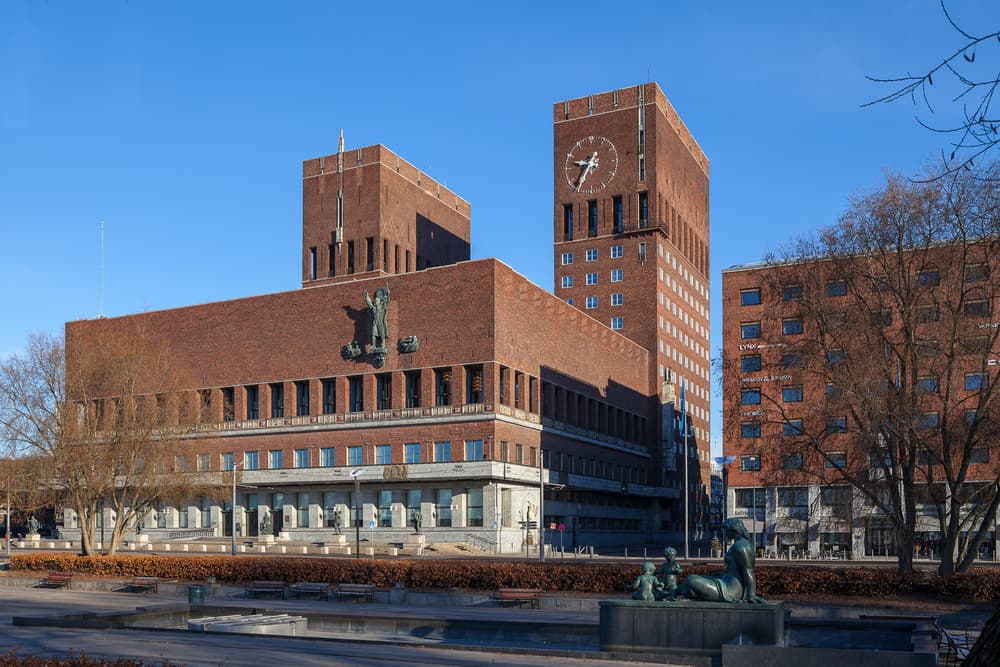
Oslo City Hall
Oslo City Hall
Located on Nansen Square, Oslo City Hall hosts the Nobel Peace Prize ceremony and a remarkable collection of frescoes depicting Norwegian history.
Situated on Nansen Square, overlooking Oslo's inner harbour, City Hall (Rådhus) serves as the seat of the municipal council and the venue for the annual Nobel Peace Prize ceremony. Its two red-brick towers, completed in 1950, dominate the waterfront and house an impressive collection of frescoes and sculptures dedicated to twentieth-century Norwegian history.
Why visit Oslo City Hall
The building combines three functions that make it worth a visit: municipal seat of power, setting for the Nobel Peace Prize, and monumental gallery of Norwegian art. Inside, over one thousand square metres of frescoes tell the story of labour, resistance, and Nordic mythology. The visit is brief (allow 45 minutes to an hour) and remains one of the few free activities in the city centre during peak season.
History of the building
The idea of building a city hall in Oslo dates back to 1906, shortly after Norwegian independence. The architectural competition, won by Arnstein Arneberg and Magnus Poulsson, was openly inspired by Stockholm's City Hall, completed in 1923. Construction began in the 1930s but was halted by the German occupation; the building was not inaugurated until 1950, marking the city's 900th anniversary.
The style, considered heavy and outdated upon completion, is today reassessed as a manifesto of Nordic functionalism applied to a civic programme. The two asymmetrical red-brick towers have become one of Oslo's harbour's most recognizable landmarks.
What to see inside
The grand hall (Rådhushallen)
This is the arrival space and starting point for guided tours. Frescoes by Henrik Sørensen and Alf Rolfsen cover the walls from floor to ceiling, depicting agriculture, industry, port labour, and resistance during the Second World War.
The banquet hall
This is where the Nobel Peace Prize is presented each 10 December. The decoration emphasizes themes of diplomacy and international cooperation, in a restrained style that contrasts with the exuberance of the grand hall.
The municipal council chamber
Panelled in wood from floor to ceiling, it is adorned with sculptures carved in the Norwegian artisanal tradition. The municipal council still holds its sessions here.
Outdoor sculptures and courtyard
The interior courtyard and façades are dotted with wooden reliefs inspired by the Edda and Nordic mythology. Take time to walk around them before or after your indoor visit.
Practical information
- Access: free entry year-round during public opening hours.
- Guided tours: free in summer (June–August), multiple time slots daily. Outside this season, private tours are available by reservation at a premium rate (group fee, not per person).
- Duration: 45 minutes to 1 hour for a guided tour; longer if you explore the artworks at your own pace.
- Accessibility: the building is accessible to people with reduced mobility; lift available.
When to visit
The most interesting period runs from June to August: this is when free guided tours in multiple languages, including English, are offered several times daily. The building remains open to the public for the rest of the year, but visits are then self-guided. In December, access to the grand hall is restricted in the days surrounding the Nobel ceremony.
How to get there
- Tram: line 12, Kontraskjæret stop, 2 minutes' walk.
- Metro: Nationaltheatret station, served by all lines, then 5 minutes' walk.
- Train: Nationaltheatret station is served by regional trains and the airport connection; it is closer to Rådhus than the central Oslo S station.
- On foot: 10 to 15 minutes from Karl Johans gate or the central station, following the waterfront.
Nearby attractions
City Hall sits at the heart of the Aker Brygge harbour district, making it easy to chain several visits together:
- Akershus Fortress, 10 minutes' walk along the quay.
- The Nobel Peace Centre, housed in the old station, just across the square.
- Aker Brygge's pedestrian quarter and terraces, ideal for a break.
- To extend your stay beyond Oslo, routes to the western fjords lead to the Geirangerfjord or Nærøyfjord, both UNESCO World Heritage sites.
Frequently asked questions
Frequently asked questions
Plan your trip
City Hall is a natural stop in discovering Oslo, to be combined with the harbour museums and Akershus Fortress. To build a full Norwegian itinerary, explore our travel ideas in Norway.
Interested in this visit?
We can include it in your personalised itinerary.