Seeing Mountain Gorillas in Rwanda: My Childhood Dream Come True
As a writer for Nomadays, I'm accustomed to amplifying the voices of our local agents and sharing the stories of travelers exploring the world.
As a writer for Nomadays, I'm accustomed to amplifying the voices of our local agents and sharing the stories of travelers exploring the world. But this time, it's my turn to share mine: the story of a childhood dream come true, just a few months ago in the heart of Rwanda's misty forests…
Since childhood, mountain gorillas have captivated me in an almost inexplicable way. Perhaps because they share over 98% of our DNA. Perhaps also because, behind their powerful and massive silhouette, they reveal a gentleness and sensitivity far removed from the stereotypes associated with them. As a child, I saw Dian Fossey as a heroine. And, year after year, my admiration for these great apes—and for the woman who devoted her life to protecting them—only grew stronger.
So I saved, patiently, with one idea in mind: to one day live my dream of encountering gorillas in their natural habitat and walking in the footsteps of my beloved primatologist to see where the fight for species preservation truly began. And so, in June 2025, this dream took shape. Accompanied by my parents and my partner, I flew to Rwanda with Nomadays' local partner agency, Mapendano Voyage. Let me tell you about it.
· · ·
Where to See Gorillas in Rwanda?
Volcanoes National Park: One of the Last Refuges of Mountain Gorillas

Observing gorillas is only possible in one place in Rwanda: Volcanoes National Park. Located in the north of the country, approximately 2 hours' drive from Kigali, this high-altitude territory forms one of Africa's most precious natural sanctuaries. Created in 1925, the park is also the oldest in Africa.
Today, it protects exceptional biodiversity, but most importantly, one of the last populations of mountain gorillas. This gorilla subspecies lives only in the Virunga region, spanning Rwanda, Uganda, and the Democratic Republic of Congo. These great apes live here because the high-altitude forests provide everything they need: abundant vegetation for food, a cool climate suited to their physiology, and steep terrain that long protected them from human presence.
Within the park, several gorilla families have been gradually habituated to human presence through strict scientific and conservation programs. This controlled habituation now allows travelers to encounter them without significantly disrupting their natural behavior, while directly funding their protection and that of local communities. In total, the park is home to 11 gorilla families habituated to humans.
Why is Rwanda one of the best places in the world to see gorillas?
Remarkable accessibility: the park is only two hours from Kigali's international airport.
Guides and trackers among the world's best-trained, often with decades of experience with gorilla families.
An extremely high sighting rate (nearly 100%), made possible by the daily tracking work of trackers.
Well-developed infrastructure, with maintained trails, professional organization, and comfortable accommodations for all budgets.
A high level of safety and stability: Rwanda is considered one of Africa's safest countries for travelers.
· · ·
Gorilla Tourism and Animal Welfare: My Doubts, My Answers

To be honest, I hesitated for a long time before taking the leap. Despite all these good reasons, doubt lingered.
As someone who has always struggled with tourism activities involving wild animals, I had many questions: Will my money truly serve to protect gorillas? Doesn't human presence disturb their balance? Is this really a responsible approach?
After watching numerous documentaries and conducting my own research, I discovered a more nuanced reality. Yes, habituation represents a stressful phase for gorillas, particularly for dominant males, as it forces them to gradually accept a human presence their instinct normally identifies as danger. Especially since this phase can extend beyond a year—a long time when animals are repeatedly exposed to this unusual presence.
But this same process has saved the species from extinction. And that is no small thing.
Indeed, the mountain gorilla population has grown from approximately 250 individuals in the 1980s to over 1,000 today. It's even the only great ape species seeing population growth today. We owe this success largely to tourism (in addition to Dian Fossey's monumental work, of course). The reason is simple: revenues from gorilla viewing permits primarily fund the fight against poaching, habitat protection, and community development.
So no, it's probably not a perfect solution if we aim for absolute respect of animal welfare. But faced with the real risk of species extinction, the balance achieved today seems, in my view, a necessary compromise to ensure its survival.
After months of doubts, reading, and reflection, the time had come to stop asking questions and go see for myself.
· · ·
The Gorilla Trek: What It's Really Like

Here we are, the night before the big day.
Excitement is at its peak. I fall asleep with my heart racing, unable to grasp that tomorrow I will live the dream that has inhabited me since childhood. Emotions run so high that I struggle to speak, even to my parents and partner. Everything feels suspended in anticipation of this encounter I've imagined thousands of times.
The Briefing: Meeting the Guides and Safety Rules
The big day arrives early.
We have a 7 a.m. appointment at the park headquarters for the information meeting. On the drive, my pulse quickens.
Upon arrival, our driver-guide, who has accompanied us throughout our Rwanda journey, takes care of verifying our permits. The day before, we had discussed my fascination with gorillas and my boundless admiration for Dian Fossey. I had confided my secret dream of meeting a family whose members might be descendants of those she had studied.
And sometimes, when you're about to touch a childhood dream, everything seems to align.
Because that morning, just before the briefing, our wonderful guide Liza approaches me and whispers:
"It's settled… you'll be able to see a family descended from the gorillas Dian Fossey studied."
Tears fill my eyes before I've even taken a single step into the forest. I can never thank him enough for that thoughtfulness.
Next comes the briefing. We meet the guide and four other travelers who will share this adventure with us. Each gorilla family can only receive 8 visitors per day, and only for a maximum of one hour (not a minute longer) to preserve their peace as much as possible. We're then explained the essential rules of conduct and safety to observe them without disturbing them (precious guidelines I detail in the sections below).
Before leaving, we're offered the option to rent gaiters to protect ourselves from mud, nettles, and ants, or to hire porters to carry our bags. A few minutes later, we're equipped and ready to go. We head back in the vehicle toward Mount Karisimbi where the gorilla group assigned to us lives: the Isimbi family.
The adventure can finally begin.
What You Need to Know Before You Go
Anyone showing symptoms (cold, flu, cough, fever, vomiting, diarrhea, open wounds, or signs of infection) is not permitted to participate in gorilla treks.
Gorillas share 98% of our DNA and are highly vulnerable to human diseases. A simple cold can be fatal to them. If you're sick on the day of your excursion, inform the rangers immediately. Depending on availability and with medical documentation, it's sometimes possible to reschedule your permit. This may seem frustrating when you've waited for this moment, but it's above all proof that this experience is built on profound respect for the animals.
The minimum age requirement to participate in a gorilla trek at Volcanoes National Park is 15 years.
Rules of Conduct During the Trek
Stay on the trails opened by trackers: never stray from the group. If you need a break, let your guide know;
Respect the forest inhabitants: speak quietly and keep noise to a minimum;
Follow the spirit of "Leave No Trace": leave no garbage behind (everything must be removed, even biodegradable waste), don't pick anything from nature (no plants, flowers, or stones...);
Follow all guide instructions: they make all decisions to ensure everyone's safety.
If you need to use the restroom: it's a detail one doesn't always think about... but it's also very strictly regulated. You must inform the guide, move at least 100 meters away from the gorillas, dig a hole approximately 30 cm deep, then carefully cover everything after. Even toilet paper use is limited, and ideally, you should pack it out.
Safety Rules to Follow When in the Presence of Gorillas
Maintain a distance of 7 meters from the gorillas;
Don't use flash for photographs: it disturbs gorillas and damages their eyes;
Remain as discreet as possible: avoid sudden movements, don't point at gorillas, stay calm and peaceful, speak in a low voice... Act as if you're not there;
Don't eat or drink in their presence: germs in food can be dangerous to them;
Never touch the gorillas: maintain distance to avoid disease transmission, wear a protective mask, cover your mouth and turn away if you need to cough or sneeze. Even if a gorilla touches you, don't touch it back.
Trekking to the Gorillas
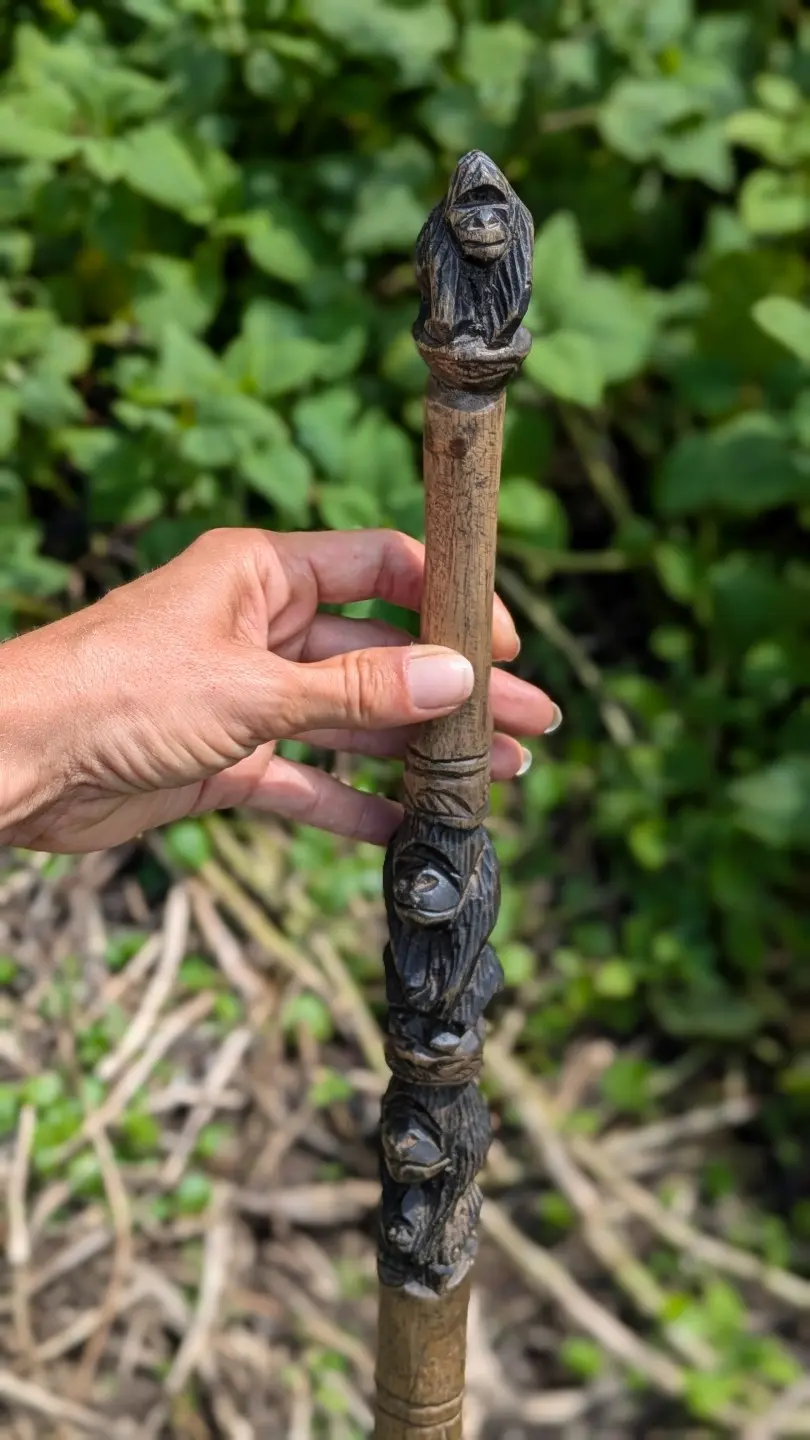
At the trail's start, we're given trekking poles. Armed rangers join us: they're there to protect us from wild animals (buffalo, elephants) if needed. We begin the hike in near silence, each lost in our thoughts.
The trail first crosses agricultural lands forming a natural boundary with the park. Between the fields and forest, wide trenches have been dug to limit wild animals' incursions into crops: a first reminder that we're about to enter a world no longer truly ours.
We then pass through magnificent bamboo and hagenia forests. Already, we're transported into another universe. Very quickly, vegetation thickens and slopes steepen. The air grows thinner at 2,800 meters altitude, effort becomes palpable... yet no one complains.
Because deep down, one thought guides us alone: at the end of this path, there are the gorillas.
From time to time, the guide receives updates from trackers who left before dawn. They follow fresh tracks, food remnants, footprints in mud. The family is drawing near. Anticipation becomes almost palpable. Then suddenly, after only 2 hours of hiking (faster than expected), the guide turns around and whispers a few words.
The trackers have made contact: they're very close now.
We gather our things in a discreet corner: bags remain behind, along with trekking poles (they might frighten the gorillas). The guide distributes protective masks we adjust on our faces to minimize disease transmission risk.
This time, it's real. The moment I've imagined my entire life is here, just meters away. Breath catches, breathing becomes short. I try to inhale, to calm myself...
I really shouldn't faint just before seeing the gorillas.
How long does the trek take? What is the difficulty level?
Trek duration depends entirely on which gorilla family is assigned to you and where they are that morning. Each family lives in a well-defined territory, typically between 10 and 30 km², as gorillas are territorial animals that move daily to feed. As a result: some encounters happen after only 30 minutes of hiking, while others require several hours of effort—sometimes up to 4 or 5 hours.
Park rangers distribute visitor groups based on fitness level, so everyone experiences the trek optimally. Difficulty ranges from moderate to strenuous, over steep, often muddy terrain, at altitudes between 2,500 and 3,500 meters. Breathlessness, steep slopes, slippery roots, and changing weather are part of the adventure… but nothing insurmountable with decent fitness and determination.
And if you need a little help, local porters can accompany you: they carry your bag, assist on difficult sections, and their wages directly support nearby communities. Expect to pay porters 15 to 20 USD.
The Gorilla Encounter

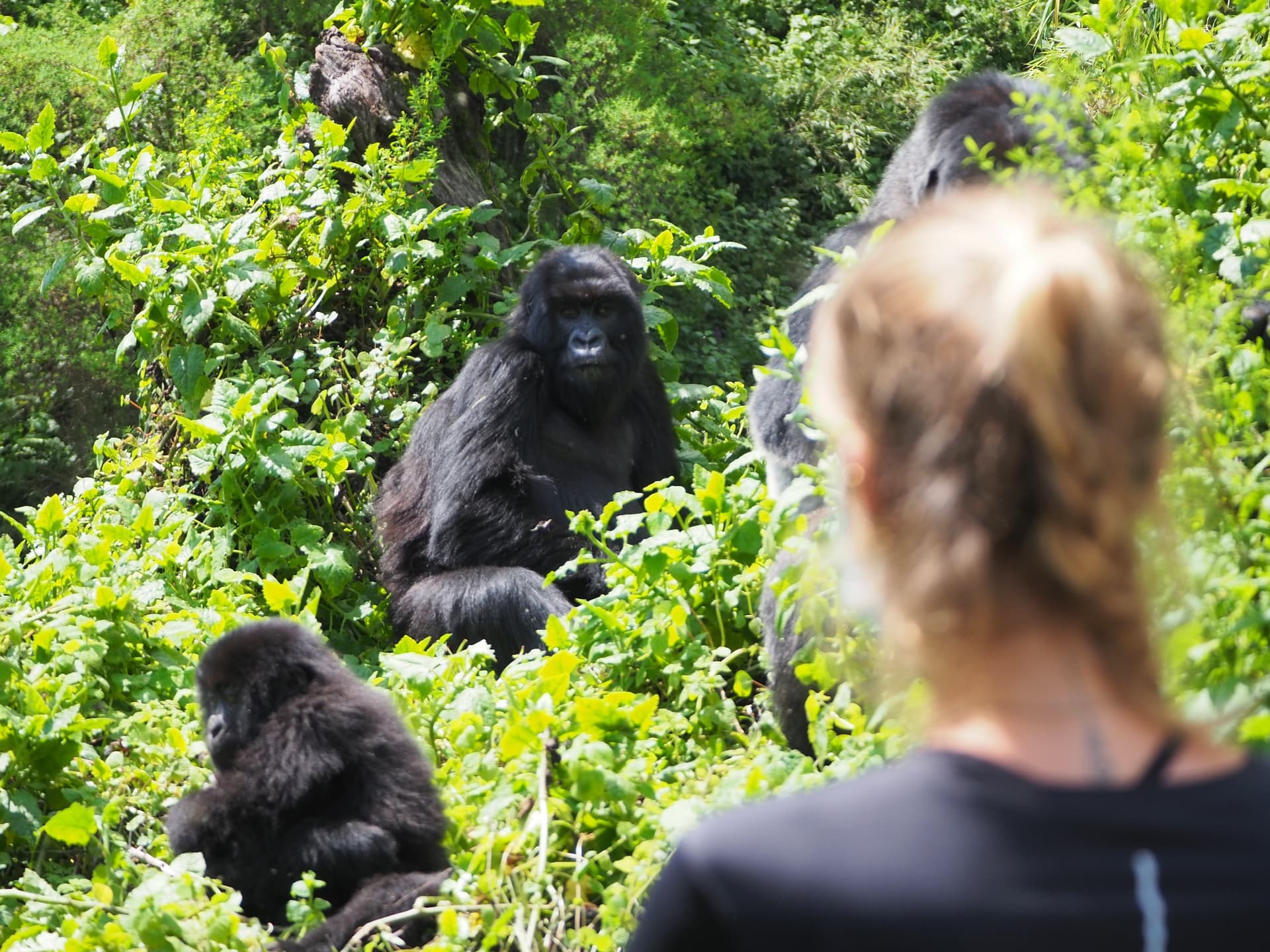
A tiny ball of black fur appears in a bamboo setting: a baby barely a year old, followed by another infant and their mother.
Eyes filled with tears, I exchange my first gazes with mountain gorillas: hypnotic, profound, and even unsettling.
We crouch to make ourselves as inconspicuous as possible. I clasp my father's hand, as if to transmit my emotions and share this magical moment, while trying to contain my feelings so they don't invade the gorillas' space.
This first contact still gives me shivers, months later.

The young gorillas play, roll in the grass... but my gaze keeps returning to their mother. She watches her little ones with quiet pride, and I think I can detect a smile at the corner of her mouth, as if she wants to tell us: "Look at my children… aren't they beautiful?"
Two juveniles come toward us next. We quickly understand they're the group's most curious and playful members. At their age, you could almost compare them to young adolescents. One climbs onto a bamboo cane before tumbling to the ground, another launches into a chase following an imaginary companion.
And then suddenly, one of them heads toward me and grasps my shoulder with a gentle yet firm grip, as if to say "want to play with us?". I'm breathless, unable to move.
Our guide then emits a deep sound, an "hm hm" from deep in the chest that wraps the atmosphere in calmness. This sound reproduces one of the gorillas' vocalizations which, in their language, means "I am here in peace." I'm especially moved by the moment because it transports me back into my many hours reading Dian Fossey's Gorillas in the Mist, in which she speaks of gorilla communication methods she was the first in the world to study.
Finally comes the appearance of the famous silverback, the group's dominant male, near us.
My mother watches me completely trembling, fascinated and terrified by this mountain of muscle over 1.5 m tall and weighing nearly 200 kg. Yet, despite his impressive mass and majestic bearing, he's the group's most calm and peaceful member. He even showed the least interest in us throughout the encounter. I'm not surprised—I know gorillas are peaceable and use violence only as a last resort.
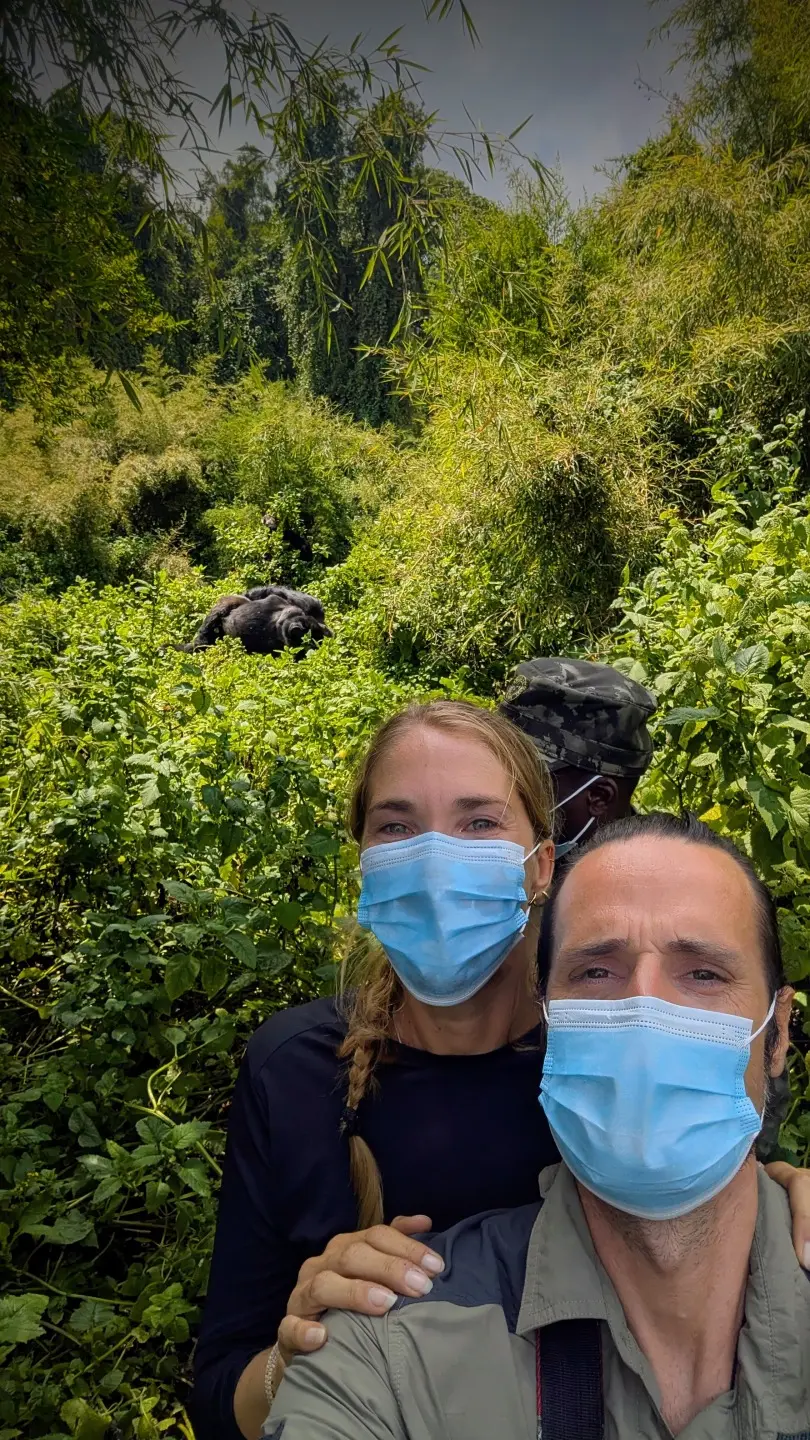
What follows are scenes of almost-human life: adults calmly plucking leaves to feed themselves, micro-naps nestled together, babies climbing on their mothers' backs, young ones roughhousing, knowing glances, profoundly human gestures and postures—and above all, so much tenderness and gentleness...
After an hour beside them, during which I never stopped crying, it's already time to leave to let them rest. Our hearts brim with gratitude for having lived this suspended interlude, our minds full of images that will haunt us for the rest of our lives.
Thank you, life, and thank you, Mother Nature, for allowing us to live all this together, as a family.
How to React When Facing Gorillas?
During the gorilla observation hour, visitors must maintain a 7-meter distance from the gorillas, but the gorillas themselves don't always respect this limit!
What to do if a gorilla approaches:
stay calm and motionless;
crouch down;
avoid direct eye contact;
simply let it pass;
never touch it back, even if it initiates contact.
What to do if a gorilla charges:
absolutely do not run (this triggers the chase instinct);
slowly crouch in a posture of submission;
look at the ground and avoid eye contact;
remain perfectly still and calm;
wait until the gorilla loses interest or moves away.
What to do if a gorilla vocalizes or beats its chest:
recognize that this is usually intimidation behavior, not an attack;
stay calm and motionless;
immediately follow ranger instructions.
The Return to Reality
On the way back down, I slowly realize what I've just experienced. For years, this dream seemed distant, almost inaccessible... and yet, it just unfolded before my eyes, in the silence of Rwanda's mountains.
But this encounter didn't mark the end of the journey. Because a few kilometers further, deep within this same forest, lay the woman who had devoted her life to protecting these gentle giants. And I was about to, in turn, follow in her footsteps and pay her tribute...

· · ·
My Practical Tips for Planning a Rwanda Trip to See Gorillas
What is the Best Time to See Mountain Gorillas in Rwanda?
✦ June–September (long dry season) ✦ January–February (short dry season) ✦ October–December (short rains) ✦ March–May (long rains)
The long dry season, from June to September, is generally considered the best time to see gorillas. The trails are drier, hiking easier, and observation conditions optimal, with often clear skies. This was the time we chose for our trip: departing in June not only allowed us to maximize comfortable trekking conditions, but also to combine this encounter with a wildlife safari in Akagera National Park, at a season when animal sightings are most frequent.

The short rainy season (October to December) transforms the forest into a spectacular green jewel. Treks remain possible, but trails become muddier. However, this is an excellent time for birdwatching, particularly for migratory species.
The short dry season (January-February) provides an excellent alternative: rainfall is limited, crowds slightly smaller, and hiking conditions favorable again.
Finally, the long rainy season (March to May) offers lush landscapes and a mysterious, often fog-wrapped atmosphere. Treks are more physically demanding due to heavy rains and slippery ground, but the experience may appeal to travelers seeking tranquility.
How to Equip Yourself for the Gorilla Trek?
Essential Clothing
Waterproof hiking boots, already broken in, with good ankle support (the most important item);
Gaiters to protect from mud, nettles, and ants (available to rent at park headquarters—highly recommended, especially if it's rained);
Long, durable pants (shorts should be avoided);
Long-sleeved, lightweight breathable shirt;
Waterproof jacket and, if possible, rain pants or protective cover;
Fleece or warm jacket for cool mornings at altitude;
Garden gloves for gripping vegetation on steep sections;
Hat or cap for sun and rain protection.
Choose neutral-colored clothing, avoid perfume, jewelry that might catch in vegetation, and camouflage patterns (prohibited in the country).
Useful Gear During the Trek
Comfortable backpack (20 to 30 L) for several hours of hiking;
At least 2 liters of water per person, essential at altitude;
Energy snacks;
High-performance camera for low light, without flash, with spare batteries;
Waterproof bags to protect electronics from rain;
Small first aid kit, hand sanitizer, sunscreen, and insect repellent;
Rain cover for your backpack and possibly binoculars for wildlife viewing.
And one piece of advice I'd give to all travelers: hire a porter. For just a few dozen dollars, they carry your bag, help on difficult sections, and represent direct support to local communities. A small gesture that changes everything—for you and for them.
How Much Does the Gorilla Permit Cost?
To see gorillas in Rwanda, you must obtain an observation permit issued by the Rwanda Development Board. This currently costs 1,500 USD per person for one hour spent with a gorilla family.
At first, this sum may seem very steep. Yet understanding what this permit actually funds completely changes your perspective.
1,500 USD
per person · high season
These revenues directly fund gorilla protection: fighting poaching, daily ranger surveillance, veterinary monitoring, and habitat preservation. A significant portion goes to local communities, financing schools, infrastructure, and development projects.
This model also maintains a delicate but essential balance between human and wildlife populations, making gorillas a resource to protect rather than a constraint to endure. In other words, this price isn't merely that of a tourist excursion: it's a concrete contribution to species survival.
Beyond the permit, other costs include: accommodation near the park, transport from Kigali, guides, guide and ranger tips, and optionally, a porter.
I'm aware the experience represents a significant investment, but I can tell you truthfully: if I had to do it over, I would without hesitation. Because what you experience facing gorillas is ultimately priceless. And looking back, I can say one thing without doubt: it was one of the most beautiful days of my life.
Good to know: Rwanda offers a 30% discount on gorilla trekking permits during low season, bringing the cost to 1,050 USD per person. As the Volcanoes Park website explains, this offer is valid from November 1 to May 31 and requires booking two nights in Nyungwe National Park or Akagera National Park.
· · ·
My Encounter with Mountain Gorillas: The Most Beautiful Day of My Life
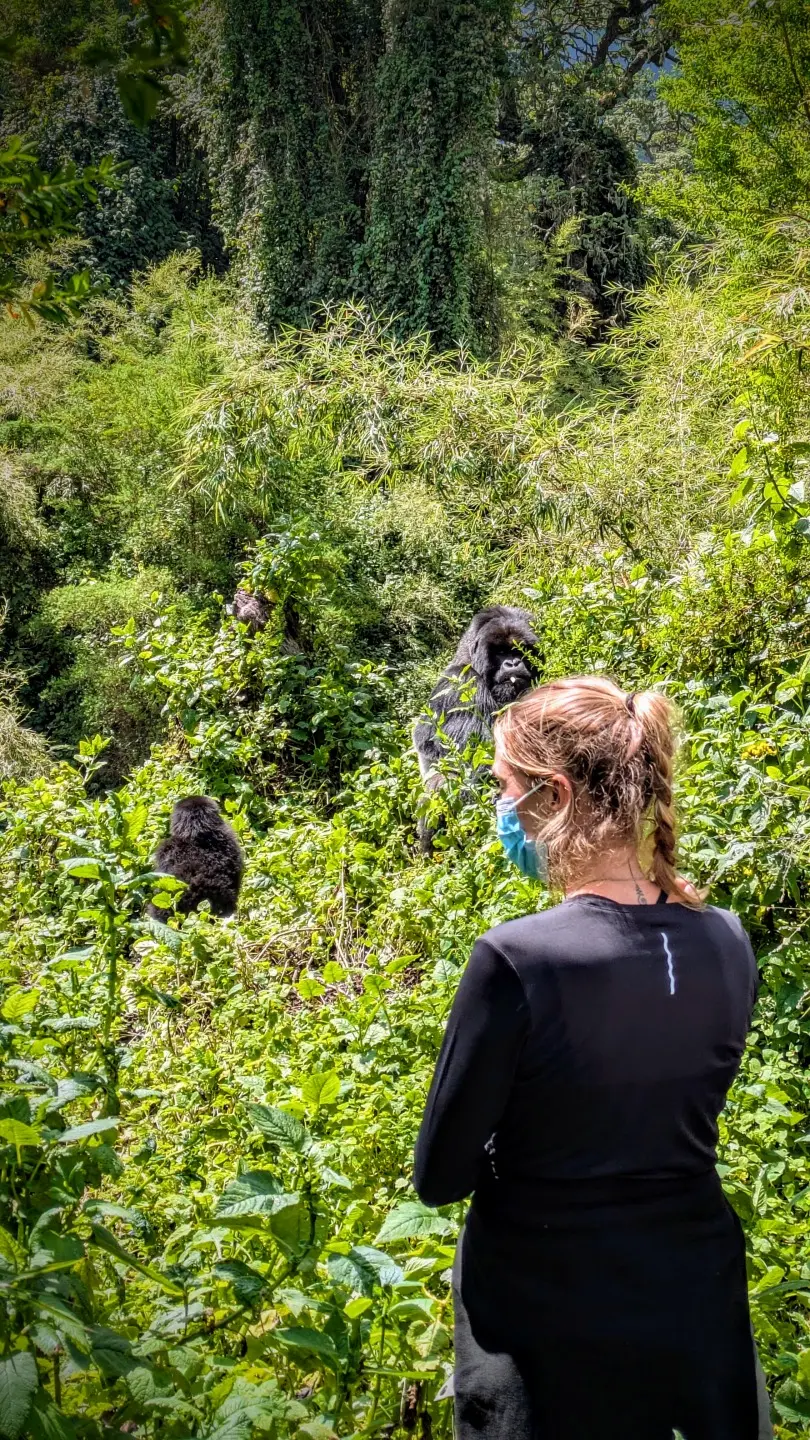
Observing a gorilla family living free in their natural habitat was even more overwhelming than everything I had imagined and dreamed of for years. I feared disappointment, having idealized this moment so much… but nothing can truly prepare you for the intensity of such a face-to-face encounter.
A dream that once seemed so vast, so distant, almost unreachable. Today, it's part of my story. And if there's one thing this adventure taught me, it's that some dreams deserve your persistence, patiently, even when they seem impossible.
So I wish with all my heart that you one day experience this unique sensation: seeing a childhood dream become reality. But also that you depart with the profound conviction that these precious moments entrust us with a responsibility: protecting the living that makes them possible.
Because, as Dian Fossey wrote so perfectly:
"
"When you understand the value of all life, you spend less time dwelling on the past and more time ensuring the future."
— Dian Fossey
The photos are not royalty-free.
Ready to experience this yourself? I can only recommend trusting the experts at Nomadays and contacting their English-speaking local partner agency, Mapendano Voyages, to organize your Rwanda trip to see gorillas. And I promise I'm not saying this just because I work there: I lived this journey as a regular client, and I was deeply moved by the team's professionalism, kindness, and passion on the ground.
Frequently asked questions
The gorilla observation permit in Rwanda is issued by the Rwanda Development Board (RDB). Its current price is approximately 1,500 USD per person for one hour spent with a gorilla family. Though high, this price directly funds gorilla conservation and local community development around Volcanoes National Park.
Gorilla trekking is possible year-round in Rwanda, but the best times are the dry seasons: June to September and December to February. Trails are less muddy, forest visibility better, and hiking conditions more pleasant. In rainy seasons (March-May and October-November), trekking remains possible but trails can be very slippery.
Trek duration varies depending on the assigned gorilla family's location that day. Some encounters happen after just 30 minutes of hiking, others require up to 4 to 5 hours of effort. Once gorillas are located, observation is limited to exactly 1 hour to preserve their peace. Plan a full day for this activity.
Volcanoes National Park in Rwanda is home to 11 gorilla families habituated to human presence. Each family receives only 8 visitors maximum per day for one hour. Groups are formed during the morning briefing and distributed based on visitors' fitness levels.
The minimum age requirement for gorilla trekking at Volcanoes National Park is 15 years. This limit exists for children's safety and to protect gorillas, which are highly sensitive to human disease. Minors must also be in good health: anyone showing symptoms (fever, cough, cold) cannot participate.
Gorilla trekking takes place on steep, muddy terrain at 2,500 to 3,500 meters altitude. Decent fitness is recommended. For those less comfortable with hiking, local porters are available (about 15 to 20 USD) to carry bags and assist on difficult sections. Park rangers also distribute groups based on each person's fitness level.