Nyungwe Forest
1,019 km² of highland forest in southwestern Rwanda, thirteen primate species and a canopy walk suspended 50 m above the forest canopy.
Nyungwe stretches across 1,019 km² in the southwest of the country, between the districts of Nyamasheke, Rusizi and Nyaruguru. It is one of Africa's oldest highland forests, remaining largely intact during the last glaciations, which explains its biological diversity. Altitude ranges from 1,600 to 2,950 m at the summit of Mount Bigugu, and this elevation gradient creates several vegetation zones: dense mountain forest in the lower reaches, bamboo formations around 2,500 m, highland marshes like Kamiranzovu, Rwanda's largest.
The park is home to thirteen primate species, a rare figure at this scale of territory. Chimpanzees are tracked through two groups habituated to human presence, one around Uwinka, the other near Cyamudongo, an isolated satellite forest to the west. Angola colobus monkeys form troops that can exceed 400 individuals, a social behavior documented here and observed on few other sites in Africa. You'll also encounter Hoest's red colobus, grey-cheeked mangabey, and silver monkeys. As for birdlife, over 300 species including some thirty endemic to the Albertine Rift, which draws ornithologists on dedicated stays.
The climate strikes visitors upon arrival. Expect 15 to 20°C during the day, nights around 10-12°C in June-July, and showers possible throughout the year. Annual rainfall exceeds 2,000 mm, making Nyungwe a major water tower: it is here that tributaries of both the Congo to the west and the Nile to the east originate. The watershed divide runs through the park itself, a geographical fact we often explain to our travelers from Uwinka's viewpoint.
Around the park lives a mainly rural population organized around tea cultivation. The plantations of Gisakura, Gisovu and Pfunda sketch a landscape of bright green hills that contrasts with the dark mass of the forest. Gisakura cooperative welcomes visits of one to two hours, where you follow the leaf cycle through to drying. Further south, the village of Banda, within a buffer zone, offers guided walks led by former poachers turned trackers. Local food centers on plantain, sorghum, beans, and isombe, a dish of mashed cassava leaves served in Kitabi lodges.
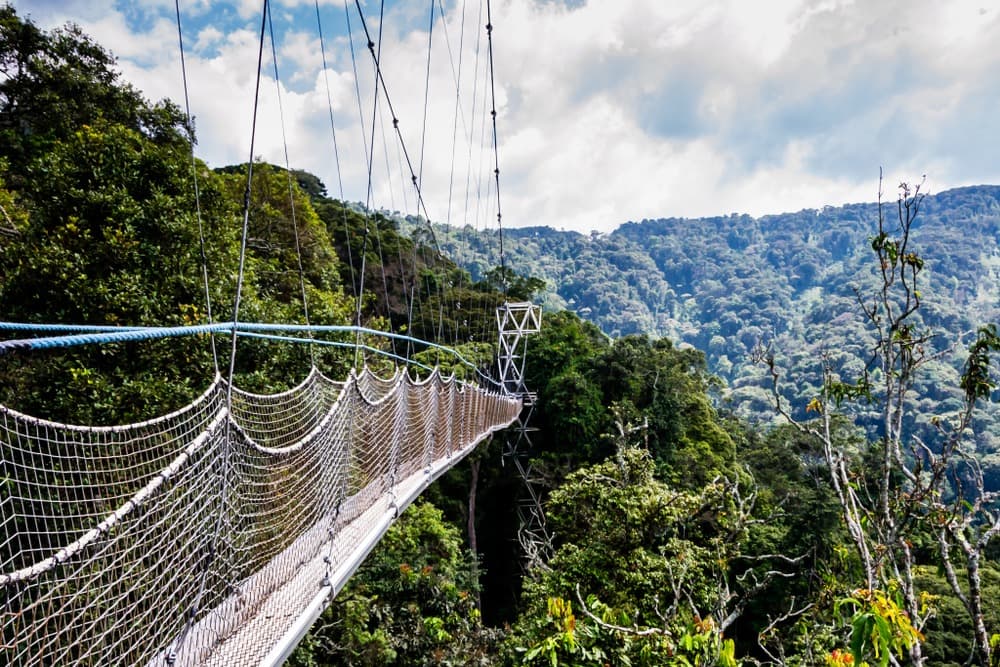
Two entrances structure logistics: Uwinka in the center, which concentrates the park headquarters and canopy walk, and Gisakura to the west, closer to Lake Kivu. The canopy walk crosses a forest gap over 200 m at 50 m height, with a central section of 90 m suspended without intermediate support. Chimpanzee tracking departures leave early, sometimes 4 a.m. from the lodge, as groups move rapidly at dawn and locating them can be lengthy on uneven terrain.
The park has around a hundred kilometers of marked trails, from the 2-hour walk on the Igishigishigi trail to the day-long Bigugu traverse. Kamiranzovu marsh, walked as a 3-hour loop, offers different vegetation: tree ferns, terrestrial orchids, giant lobelias. It's unspectacular at first glance but of great botanical value, and our local guides read traces of elephants that vanished some decades ago.
To discover
Chimpanzee tracking at Cyamudongo. Departure before dawn from Gisakura, 1 to 4 hour walk in a 4 km² satellite forest where a group of around thirty chimpanzees inhabits a restricted territory, increasing chances of close observation.
Uwinka canopy walk. Walkway suspended 50 m above ground, 200 m long, traversed in 30 to 45 minutes depending on pace. Bird's-eye view over giant rubber trees and continuous canopy toward the Nyamasheke hills.
Angola colobus troop. 2 to 3 hour outing from Uwinka to follow a troop that can gather over 400 individuals, a rare social aggregate. Colobus move in cascades through tall trees with their characteristic black and white fur.
Kamiranzovu marsh. 3-hour loop on boardwalk and trail through Rwanda's largest highland swamp, at 1,950 m. Tree ferns, endemic orchids, and morning mist that sometimes doesn't lift until midday.
Gisakura tea cooperative. 1 to 2 hour visit in a plantation on the park's edge, from manual picking of young shoots to sorting at the facility. Good cultural complement after a morning in the forest, 10 minutes from the lodge.
When to go
Nyungwe can be visited year-round but conditions vary considerably. The long dry season, June to September, remains most comfortable for walking: fewer rains, less slippery trails, temperatures of 16-20°C during the day and 10-12°C at night. July and August concentrate visitors; chimpanzee permits must be reserved weeks in advance. The short dry season, mid-December to mid-February, offers a quieter window with similar conditions, sometimes slightly warmer at 18-22°C.
Rainy seasons, March-May and October-November, need not be excluded: the forest is more active, chimpanzees come lower to feed, waterfalls like Isumo cascade run at full force. But you must accept daily showers, sometimes 50 to 80 mm in a single afternoon, and secondary trails impassable. We always equip our travelers with ponchos and gaiters, and recommend well-broken-in hiking boots: even in dry season, the forest floor remains damp.
Practical advice
We recommend a minimum of 2 nights on site, ideally 3, to combine a primate activity, the canopy walk and a forest walk without chaining everything in fatigue. Access is by road from Kigali, 5 to 6 hours via Huye and Nyamagabe, or from Kamembe (regional airport 2 hours from Gisakura) with a domestic flight of around 45 minutes. The Huye-Nyungwe road crosses landscapes of cultivated hills that justify taking the car at least one way.
The most logical combination is with Lake Kivu, 2 hours' drive from Cyangugu, to decompress after high-altitude walks: we often chain Nyungwe then Kibuye or Rubavu lakeside. For a complete Rwanda circuit, the classic order is Kigali, Akagera to the east, then crossing to Nyungwe in the southwest, heading back via Kivu and arriving at the volcanoes in the north. Lodge comfort ranges from simple standard at Kitabi to more refined establishments near Gisakura. Nyungwe suits regular walkers, ornithologists, and contemplative travelers who accept humidity and early departures. Less suited to young children on chimpanzee tracking, where the minimum age is 15 years.