Volcanoes National Park
Volcanoes National Park
In northwestern Rwanda, Volcanoes National Park is home to mountain gorillas, the Virunga volcanic chain, and the Karisoke Research Center founded by Dian Fossey.
Volcanoes National Park stretches across northwestern Rwanda, near Musanze, along the Virunga chain. It shelters a significant portion of the world's mountain gorilla population and stands as the cradle of conservation efforts for this species, from Carl Akeley to Dian Fossey.
Why visit the park
Three compelling reasons justify a detour to this park. First, observing mountain gorillas in their natural habitat: a species whose global population numbers around 1,000 individuals, roughly one-third of which live here. Second, climbing volcanoes reaching over 4,000 meters, with landscapes that shift from bamboo forest to alpine moorland. Third, a major scientific legacy tied to Dian Fossey's work, whose research center still stands within the park.
The park covers approximately 160 km² between 2,000 and 4,000 meters in altitude. It encompasses five of the eight Virunga volcanoes: Karisimbi (4,507 m), Visoke (or Bisoke), Muhabura, Gahinga, and Sabyinyo.
Park history
The park's history begins with a paradoxical figure: Carl Akeley, an American big-game hunter, taxidermist, and sculptor, and friend of Belgium's King Albert I. After a safari in Rwanda, Akeley became aware of the threat to gorillas and advocated for their protection. In 1925, he obtained from the Belgian king the creation of Albert Park, the continent's first national park. The zone was expanded in 1929 to include the Rwandan side of the mountains.
After Belgian Congo's independence in 1960, the reserve was divided. The Rwandan portion became Volcanoes National Park, while the Congolese side became Virunga National Park.
Another major figure in the park's history is American primatologist Dian Fossey (1932–1985). In 1967, she founded the Karisoke Research Center between the Karisimbi and Visoke volcanoes. Her fieldwork transformed knowledge of mountain gorillas and alerted the world to poaching threats. Fossey was murdered in 1985 at her research site under circumstances never fully clarified. She is buried at the center, near the tomb of her gorilla, Digit. The 1988 film Gorillas in the Mist brought her story to international acclaim.
Tourism halted between 1994, during the Tutsi genocide, and 1999. Since 2005, the annual Kwita Izina ceremony officially names baby gorillas born that year, symbolizing the species' place in Rwanda's conservation policy.
What to see and do
Mountain gorilla trekking
This is the park's signature activity. Trekking is strictly regulated: 32 permits issued daily, divided into groups of maximum 8 visitors, with one hour of observation once the gorilla family is located. The approach hike, led by rangers and trackers, lasts one to several hours depending on the group's location on the day of your visit. Each family comprises 7 to 35 individuals, led by a silverback.
Volcano climbs
Two hikes stand out. Climbing Karisimbi (4,507 m) takes two days with a high-altitude bivouac. Bisoke, more accessible, can be summited in a round trip of about 6 hours and leads to a crater lake at the peak. Several other trails explore Muhabura or Gahinga.
Other primates and wildlife
The park also hosts golden monkeys, viewable on a dedicated trek, as well as black-and-white colobus, blue monkeys, olive baboons, and forest hogs. Approximately 200 bird species and 245 plant species are recorded, including moss-covered Hagenia, giant lobelias, and alpine groundsels characteristic of higher elevations.
Karisoke Research Center and Dian Fossey's tomb
A half-day hike leads to the former Karisoke Research Center site and Dian Fossey's tomb, surrounded by those of the gorillas she devoted her research to. The route is demanding but manageable for hikers in good condition.
Practical information
Mountain gorilla trekking relies on a system of named permits managed by the Rwanda Development Board. Permits should be reserved well in advance, particularly during high season, through an agency or directly with the organization. Rates are high and regularly revised; budget generously for this activity alone.
Bring sturdy hiking shoes, waterproof clothing, gloves (giant nettles are common), and gaiters. Altitude and humidity warrant serious equipment, even outside the rainy season.
When to go
The park is open year-round, but dry seasons offer the best trekking conditions. The main dry season runs approximately June through mid-September, the short dry season from mid-December through February. During these periods, trails are less muddy and volcanoes more often clear. Rainy seasons (March–May and October–November) remain accessible but require suitable gear; they offer lush vegetation and fewer crowds.
How to get there
The park lies approximately 120 km from Kigali via RN4, about 2 to 3 hours' drive on an asphalted road through rolling landscapes. From Musanze, the park entrance is roughly 14 km away. Three main options dominate:
- Regular buses or minibuses between Kigali and Musanze, then taxi or moto-taxi to the entrance.
- Private transfer from Kigali, more comfortable and flexible, often arranged by your accommodation.
- Organized tour by an agency, typically including transport, lodging, and permits.
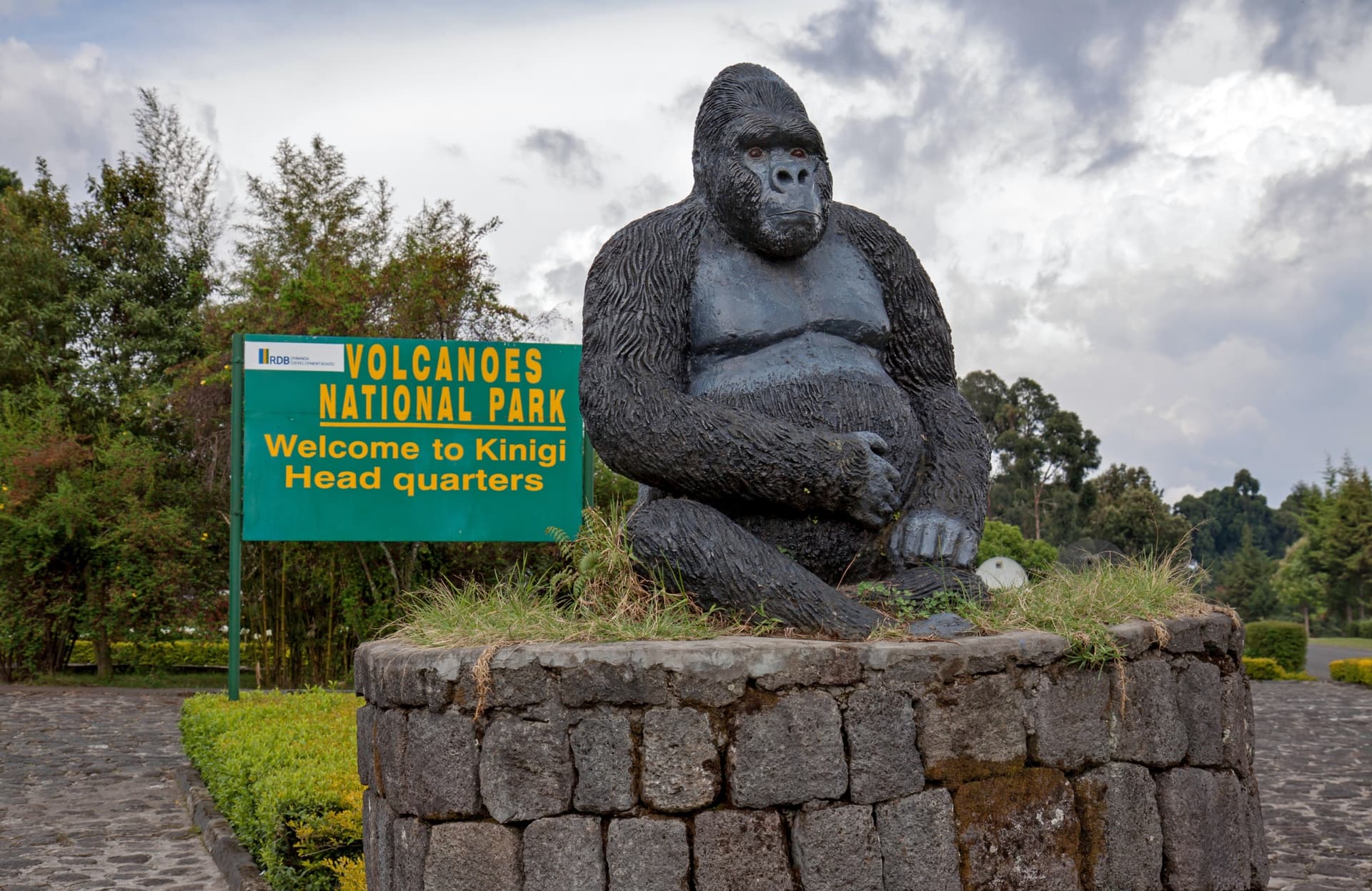
The early-morning meeting at Kinigi headquarters (the trekking registration point) practically requires staying overnight in Musanze or at a nearby lodge.
Nearby attractions
Several stops complement a park visit well. Musanze serves as a logistical base and provides access to Musanze Caves, a network of volcanic caverns. Further west, Lake Kivu offers a few days of relaxation by the water after trekking exertion. For cultural and memorial context, the Kigali Genocide Memorial and the reconciliation village of Mbyo provide essential insights into the country's recent history.
Frequently asked questions
Frequently asked questions
Plan your trip
Volcanoes National Park fits naturally into an itinerary combining trekking, Lake Kivu, and memorial sites. To craft a bespoke journey, consult our Rwanda travel suggestions.
Interested in this visit?
We can include it in your personalised itinerary.