Royal Palace Museum (or Museum of the Kings' Palace)
Royal Palace Museum (or Museum of the Kings' Palace)
Located 2 km from Nyanza, the Royal Palace Museum brings together a replica of the traditional Rwandan palace, the royal residence of 1931, and the sacred Inyambo cattle.
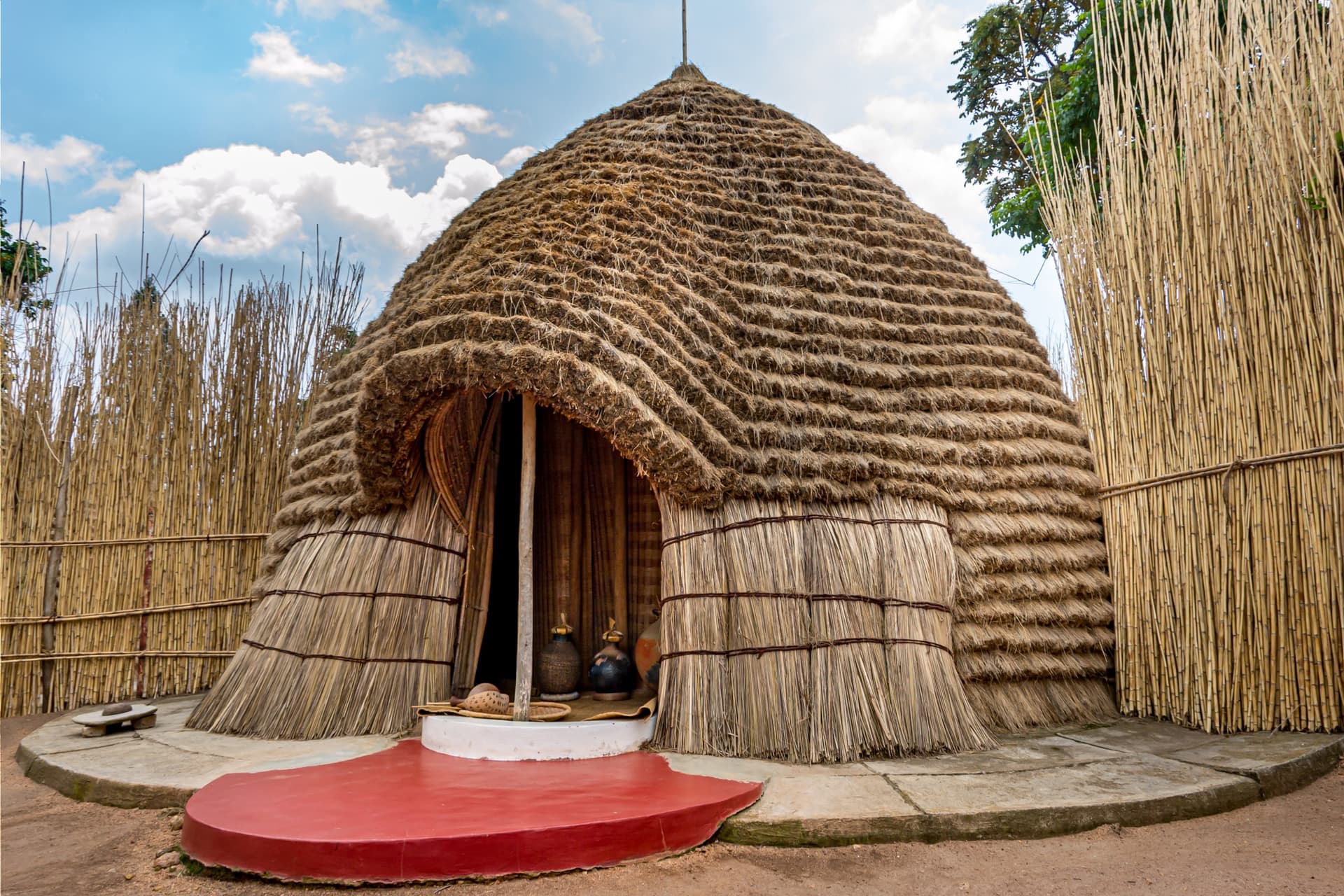
The Royal Palace Museum of Nyanza, also known as the Museum of the Kings' Palace, sits on a hillside 2 km southwest of the town. Open to the public since 2008, it traces the history of the Rwandan monarchy until the kingdom's abolition in 1961. The site brings together a replica of the traditional thatched palace and the modern residence of King Mutara III Rudahigwa, in what was long Rwanda's political and spiritual capital.
Why visit the Royal Palace Museum
Few sites in Rwanda offer such a tangible understanding of pre-colonial culture. The visit combines three complementary dimensions:
- Vernacular architecture, with a royal hut in beehive form reconstructed using 19th-century techniques.
- Colonial heritage, through the 1931 residence designed by Belgian engineers.
- The Inyambo cattle, an Ankole breed with long horns, presented in enclosures with their handlers.
Allow 1.5 to 2 hours to tour both palaces and observe the herd. Explanations are primarily in English and can be enriched by an English-speaking guide if historical context matters to you.
History of the site and the monarchy
Nyanza was the capital of the Rwandan kingdom under several Mwami (kings), whose reign spanned centuries before colonization. The city notably hosted the court of King Mutara III Rudahigwa, a figure of modernization and transition toward Belgian administration in the first half of the 20th century.
The replica visible today reproduces the traditional palace built by King Yuhi V Musinga in 1890. The walls and roof use original materials: dried grass, wood, raffia, and bamboo. The modern palace was erected in 1931 for Mutara III. During the 1994 genocide, some original furnishings disappeared: certain displayed pieces are replicas, while others have been preserved.
What you see on site
The traditional palace
The complex comprises three huts with distinct functions:
- The king's hut, guarded by sentries, recognizable by its thatched roof in beehive form crowned with three sticks. Inside, woven mats cover the floor: this is where the Mwami received male guests. At the back, the queen's private sitting room opens onto the royal chamber.
- The young woman's hut, responsible for milking the royal cattle and preserving the milk. This sacred duty was entrusted to a young unmarried woman.
- The young man's hut, responsible for producing and storing ikigage and other royal alcohol.
Before entering, you must remove your shoes, in keeping with custom.
The modern palace (1931)
Built by Belgian engineers, this building combines colonial restraint with royal purpose. It houses residential quarters, bedrooms, three reception rooms for Belgian dignitaries, and a basement where alcohol and fresh milk were stored. Signs indicate areas where photography is prohibited.
The Inyambo cattle
Introduced to the site in 2011 by the Rwandan agricultural authority, the Inyambo are brown-coated Ankole cattle. Their horns can reach 2.5 meters. Symbols of prestige, they held a central place in royal ceremonies. Handlers still sing lullabies to them; during parades, they are adorned with collars and ornaments.
Displayed objects
The interiors of the huts and modern palace house:
- Spears, shields, bows and arrows used by the court;
- Household utensils and royal drums;
- Imigongo patterns, Rwandan geometric art in relief made from cow dung;
- Agaseke baskets that held royal clothing;
- Musical instruments, ceremonial garments, and ritual accessories.
Practical information
The museum operates standard ticketing with moderate rates (differentiated for residents and non-residents). Plan to spend about 1.5 to 2 hours on site.
- Closed each April 7, the national genocide commemoration day. Hours are restricted during the week of mourning that follows.
- Closed the last Saturday of each month, dedicated to Umuganda (mandatory community service).
- Remove shoes before entering the traditional palace.
- Photography is permitted in the huts; restricted areas are marked in the modern palace.
- Explanatory panels are primarily in English.
How to get there
From Kigali
Nyanza is located 88 km south of Kigali, approximately 2 hours by road via RN1 toward Muhanga. Buses depart regularly from the Nyabugogo bus station; the journey takes 2 to 2.5 hours.
From Huye (Butare)
Plan for 30 km and 30 to 45 minutes by car via RN1. Local minibuses serve the Huye–Nyanza route; tell the driver you're getting off near the museum.
From Nyanza town center
The site is a short distance from the center. A motorcycle taxi reaches the entrance in minutes.
Combine with sites in the region
Southern Rwanda's region allows you to link several cultural sites:
- The Ethnographic Museum of Huye, 30 km away, offers the country's most comprehensive museum collection on Rwandan culture.
- On the way back to the capital, the Kigali Genocide Memorial provides essential insight into recent history.
- The village of Mbyo illustrates post-1994 reconciliation efforts.
- To extend into nature, Lake Kivu is accessible within a few hours' drive to the west.
Frequently asked questions
Frequently asked questions
One to two hours are sufficient to tour the three traditional huts, the modern palace, and observe the Inyambo cattle. Allow more time if you hire a guide for historical explanations.
Yes, in the traditional palace huts after removing your shoes. In the modern palace, certain rooms are off-limits for photography: follow the signs and staff instructions.
Yes. The museum closes each April 7 (genocide commemoration) with restricted hours during the week of mourning that follows. It also closes the last Saturday of each month for Umuganda, the national community service day.
Explanatory panels are written in English. For a visit with deeper guidance, it's best to arrange an English-speaking guide in advance through your agency or at the ticket office.
Plan your trip to Rwanda
The Royal Palace Museum fits naturally into a southern Rwanda cultural circuit combining Nyanza, Huye, and travel toward Lake Kivu or Nyungwe National Park. To build a custom itinerary including this stop, explore our suggestions for Rwanda travel.
Interested in this visit?
We can include it in your personalised itinerary.